Get involved now in redesign of Glen Canyon Dam operations

This is an important opportunity to begin getting involved in redesigning Glen Canyon Dam operations. Presentations are taking place in the six venues displayed below at the listed times. Please consider making the points made in the Grand Canyon Trust’s scoping document.  Thank You.

Long-Term Experimental and Management Plan EIS:
Talking Points on Scoping

Glen Canyon Dam water release during 2008 high-flow experiment

Interior will shortly begin public scoping for the Long-Term Experimental and Management Plan (LTEMP) EIS, which will be the first re-examination of Glen Canyon Dam operations since 1996 when fluctuating flows became the default method for operating the dam. As expressed on the Bureau of Reclamation website: “The LTEMP EIS will evaluate dam operations and identify management actions and experimental options that will provide a framework for adaptively managing Glen Canyon Dam over the next 15 to 20 years.”

Background

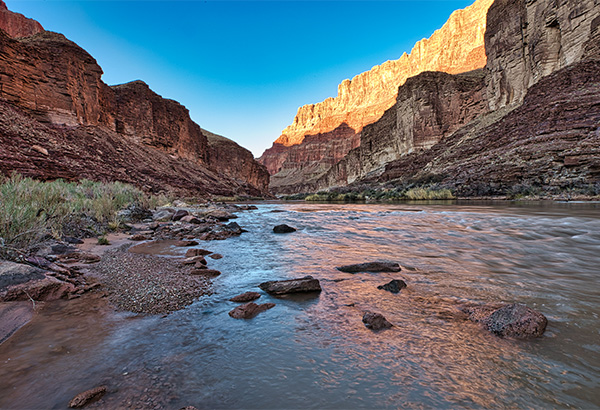
Before Glen Canyon Dam’s existence, Grand Canyon was characterized by huge sweeping beaches built up with raging snowmelt floods in the spring. The wind picked up the beach sediment and carried it inland, burying a multitude of archaeological sites. Water temperature varied from freezing in the winter to a balmy 85 degrees in the summer. Eight native fish, supremely adapted to these harsh conditions, thrived in the mainstem and tributaries. River runners during the twentieth century began taking advantage of these huge beaches for camping.

Glen Canyon Dam blocked the Colorado River in 1963 and initiated a cascade of ecosystem changes. The dam traps about 85 percent of the annual sediment supply for Grand Canyon — the other 15 percent coming from tributaries within the canyon. In addition, water releases from the dam were altered to generate the maximum amount of peaking hydropower. The loss of sediment supply and the greatly increased rate of erosion from flows designed to maximize hydropower set in motion the continual loss of sediment from Grand Canyon. Research on annual sediment balance has shown only one year when Grand Canyon has not lost sediment, and this one positive year resulted from a unique sequence of late season flood events.

The loss of sediment from Grand Canyon has resulted in fewer and smaller beaches. It has also eliminated significant critical habitat for native fish. Sediment deposits create complex shorelines and underwater features that are used by native fish for spawning
and rearing. Four of the eight species of native fish that once plied the
waters of Grand Canyon have already been lost. A fifth species, the endangered
humpback chub, is vulnerable to being lost from Grand Canyon because virtually
all spawning and rearing habitat has disappeared from the mainstem.

The continual loss of sediment from Grand Canyon has also resulted in archaeological sites being exposed to erosion and impacts from visitors. Historically, these sites were protected with a regularly renewed layer of sediment derived from the beaches and transported by the wind. Without the influx of new sediment, we constantly lose these irreplaceable features of our cultural heritage.

NPS 2011 Humpback Chub Translocation to Shinumo Creek from Colorado River

The way in which water is released from Glen Canyon Dam has profound effects on the river corridor, the species living there, and the abundant cultural sites. Simply stated, water can be released as either steady flows or fluctuating flows. Neither flow regime impacts water supplies or water deliveries by the Colorado River; however, over the last 15 years, science has shown that fluctuating flows damage all the key resources in Grand Canyon–the beaches, the backwater habitats for native fish spawning and rearing, the native shoreline plants and animals, and cultural and archaeological sites. At the same time, scientists have concluded that steady flows are very likely to be optimal for all sediment-related resources. A recent report from Grand Canyon Monitoring and Research Center concluded that fluctuating flows following the last high-flow experiment quickly eviscerated the benefits created by the high flow.

Ideally, two types of flows are needed: 1) regular high flows under sediment-enriched conditions to deposit sediment from tributaries and to scour sediment from the bottom of the river to rebuild beaches and near shore habitat for native fish, and 2) seasonally-adjusted steady flows, based on the natural rhythms of the pre-dam river, which would preserve beaches, protect native fish habitat, and stabilize centuries-old cultural sites.

Talking Points

• Develop a “Grand Canyon First!” alternative, one that achieves the requirements of the Grand Canyon Protection Act. Science has consistently concluded that regular high flows under sediment-enriched conditions combined with seasonally-adjusted steady flows will most closely mimic pre-dam conditions and perform the best for Grand Canyon resources—including the beaches, native fish, and cultural sites. And this flow regime will not compromise in any way the Law of the River or Colorado River Compact. It is all about
regulating the types of flows, not the volumes of water distributed to the states.

• Ask that Grand Canyon Monitoring and Research Center (GCMRC) be involved in the development of dam operations alternatives and analyzing the pros and cons of different flow regimes.

• The LTEMP EIS needs to seriously re-examine the effects of the existing flow regime – Modified Low Fluctuating Flows (MLFF) – and consider replacing it with a long-term alternative better for Grand Canyon resources. This process should not be about creating a five-year experiment.

In short:

1) Develop a high flow/steady flow alternative;

2) Involve GCMRC in the science development; and

3) Look at the long-term.

 
Public Scoping Meetings Schedule

Monday, November 7, 2011, 6 p.m. to 8 p.m., Phoenix, AZ
Sheraton Crescent Hotel
2620 W. Dunlap Avenue, Phoenix, AZ 85201
Register for Meeting

Tuesday, November 8, 2011, 6 p.m. to 8 p.m., Flagstaff, AZ
Radisson Woodlands Hotel Flagstaff
1175 W. Route 66, Flagstaff, AZ 86001
Register for Meeting

Wednesday, November 9, 2011, 6 p.m. to 8 p.m., Page, AZ
Courtyard Page at Lake Powell
600 Clubhouse Drive, Page, AZ 86040
Register for Meeting

Tuesday, November 15, 2011, 6 p.m. to 8 p.m., Salt Lake City, UT
Hilton Salt Lake City Center
255 South West Temple, Salt Lake City, UT 84101
Register for Meeting

Wednesday, November 16, 2011, 6 p.m. to 8 p.m., Las Vegas, NV
Ramada Las Vegas
325 East Flamingo Road, Las Vegas, NV 89169
Register for Meeting

Thursday, November 17, 2011, 6 p.m. to 8 p.m., Lakewood, CO
Sheraton Denver West Hotel
360 Union Boulevard, Lakewood, CO 80228
Register for Meeting

Share
This entry was posted in Grand Canyon Issues. Bookmark the permalink.

Comments are closed.