Canyon Metaphor: a river-running essay by Kat Wilder

The following essay was written by Kathryn (Kat) Wilder following a Grand Canyon Trust sponsored river-running trip through Grand Canyon. The Grand Canyon Trust thanks her for the personal insights.

CANYON METAPHOR 

Kat (mostly hidden by water on front left of raft) barrels through Lava Falls. Photo by Phil Pearl

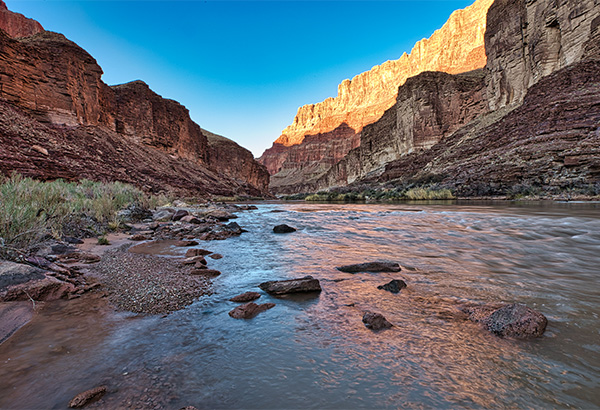
We’re floating upside-down.  Days above Lava Falls, miles downstream of Crystal and the Gems, our gazes focus not on the river or canyon or even the boat but on the sky above, which, as we move silently along with the current, becomes its own river, the canyon rim shape-shifting to riverbank.

The raft is right-side-up.  We did not flip.  In this long stretch of slow water, Kevin, the paddle captain, instructed us to lean back as far as we dared, and look up.  A crewmate whispers that the sky is moving; I agree.  But my hair drags in the water, confusing me.

Kevin’s voice gently parts the silence.  One by one we sit up and grab our paddles, blades slipping into the water in quiet unison.  Ahead of us, maybe thirty feet away, a desert bighorn stands motionless on shore, watching as we approach in the up-current of an eddy.  Kevin’s camera is ready for the shot.  The ram, his horns sweeping toward a full curl, stares through eyes the color of a mountain lion’s, his arch nemesis.  We are nine feet away when he turns, takes a few steps, and head-butts a basalt stone, the sound cracking open our minutes of silence as we marvel and chatter.  From the bank the ram follows us as we re-enter the downstream current, dropping his head to browse when we float away.

It’s moments like these, filled with the life of the canyon, that have brought me back to the river over a course of years.  AlthoughLavaFallsawaits downstream (my own arch nemesis), it is not the rush of rapids I seek but the solitude, the quiet, the serenity of this river.  Why, then, would I choose to float it as a passenger on a commercial trip?

I came down here three times in the last century.  As a swamper (someone assisting the guides with the grunt work), I stayed apart from the group, sleeping on the boats, taking baths and washing clothes on the nights off from cooking, floating on or rowing the baggage boat; just the boatman and me, our conversation reduced to grunts and chin juts and responding murmurs.  Having worked on that side of a raft, I have feared this side—the constant companionship and conversation, clustered sleeping arrangements, breakfast lines full of chipper people.  This is not me, not my rhythm, my need for solitude perhaps nearing phobic proportion.

Yet I knew the river could carry whatever I brought, including discomfort.  Knew too, or expected at least, that a trip with a theme and a group with common concerns for Grand Canyon and the Colorado Plateau would be easier to embrace.  So I bravely committed to these fourteen days.  Because I have faith—in both the river and the Trust.  Neither has disappointed me.  Although a surprising number of passengers came aboard knowing little about the Grand Canyon Trust and the work it does across the Plateau, an openness to and concern for the wildness of this place has grown staunchly within us, guided by the Trust people aboard, AZRA’s guides, and water and stone.

~~~

I have paddled many days, volunteering when empty seats needed to be filled, but on Day 10 I go to Kevin for the first time and ask to paddle on one specific day:  Day 12.  Lava Day.  “LavaFallsscares the shit out of me,” I say.  My fear is built upon respect for the river and what it can do—I’ve been there, felt the power of that water, bear a scar on my heel to tell the tale.  “I think I have to get back on that horse,” I say.  Kevin doesn’t mind my mixed metaphors.  We talk about the rapid.  I fear I will swim.

“It’s only water,” Kevin says.

I think about that.  I have swum rapids on other rivers, felt each limb pulled in a different direction by the currents, and came away bruised head to toe.  But Kevin is speaking literally.  Lava is only water—big, powerful water, without any rocks or logs or strainers to bump into or grind up against.  Still, it’s Lava.

To some, Lava is only one of the fiercest rapids in the Canyon.  Others show their extra respect.  Our guides don neckties and a fishnet outfit for the occasion (okay, only the girl guide wears fishnet).  Despite their costumes, they scout solemnly.  Kevin huddles with his six paddlers, showing us the run, explaining what to do if we get ejected from the boat.  Lava looks different to me at this low water—worse.  It’s only water, I repeat, a mantra.

We watch the oar boats go through—beautiful runs all—then it’s our turn.  I feel like puking.  Kevin cinches my lifejacket up so tight I think I might.  I’m sitting front left.  Like Seat 1 in an outrigger canoe—Stroker.  Kevin has told us that on one trip his paddlers paddled forward with such fury they off-loaded him.  We must not buck Kevin off!  I keep my rhythm slow and steady, wanting it easy for the others to follow.  The smooth clear water above the rapid gathers into a constriction made by volcanic flows millions of years ago—I can’t see the frothy side-waves below or the Ledge Hole, but I know they’re there.

As we drop over the edge of the falls, the rush of big water swallows us.  I strain to hear Kevin above the roar, my intuition reading the water when I can’t. My memory and all those years stroking outrigger canoes through huge ocean waves guide me, and my paddle keeps going rhythmically forward, hitting water, hitting air. “Hold on!” Kevin yells; I hear him and reach for the handhold as rehearsed and miss, and the same wave that shredded my heel crashes in on top of me, pulls me, wants me. My stirrup blown, I‘m held in by the same water, and then again there’s air, and my paddle and rhythm and stroke all working together—I’m still in the boat, we all are, even Kevin—and there’s more big water, more waves, more strokes, and we rise and fall and splash and, finally, laugh as we clear the mayhem and ride the tail waves down.  “Paddles up!” Kevin calls and we salute him, each other, the river—we’ve done it—we just rode the hell out ofLavaFalls.

Sitting in the sun on the basalt ledges afterward I remember my first time through Lava fifteen years ago; remember sitting on the same ledge crying into my peanut butter-and-jelly sandwich for no reason other than relief, perhaps, or joy (the ripped heel would not hurt until later).  This time, the sun warming my back, clasping an almond butter-on-lettuce sandwich with a new friend sitting beside me, tears again appear.  Tears of gratitude.

~~~

The day after Lava, I’m floating upside-down.  I paddled the morning shift then came to the trip leader’s boat, where I rode, and rowed, during the first three days those eons ago at the beginning of this journey.  I want to slow down, be still, and connect—with the trip leader, the other passengers, and the river.  I lie back on the tube, sun penetrating wet skin, and look up at the canyon walls and river of sky.  Not everyone was on Kevin’s paddle raft during Lava or that first upside-down day, but every person—guide, assistant, Grand Canyon Trust employee, passenger, me—has met self- and river- and Canyon-imposed challenges and found, despite whatever difficult obstacles rose in their paths, his or her moments of serenity.

“It’s only water,” Kevin said, knowing that water is the best metaphor for life, with its rapids and falls, its conflicting currents, the eddies and pools.  Because water is life.  Without it, we have nothing.  This right here—this river, which carries drops from seeps and springs and streams and other rivers, which carries the memories and stories of a planet’s evolution—this river is the voice of the land it drains, of the land it feeds when it cycles back as rain.  Protecting this river is the heart of the Grand Canyon Trust’s work.  Loving it is the easy part.

Share
This entry was posted in Grand Canyon Issues, Other News. Bookmark the permalink.

Comments are closed.