
Uranium and arsenic levels in the sump at Pinyon Plain Mine are more than 3,000 times higher than safe drinking water levels, company data shows.
A common yet dangerous occurrence in the hardrock mining world is happening at the controversial Pinyon Plain uranium mine (formerly Canyon Mine), south of Grand Canyon National Park. It has to do with water inside the mine.
Groundwater continues to drain into the mine, requiring constant removal. And the quality of the water pumped from the bottom of the mine is getting worse as mining operations that started in late 2023 continue. This is according to recent data mine owner Energy Fuels Resources submitted to the Arizona Department of Environmental Quality.
The total volume of water pumped out of the mine has now topped 80 million gallons. And the levels of dangerous contaminants in that water, including uranium, arsenic, and lead, are skyrocketing. While the mine operator has repeatedly brushed off draining groundwater and deteriorating water quality as “normal,” this presents risks for the Grand Canyon region.
At the same time, the company is asking state regulators to increase the limit on the amount of arsenic allowed in one of the monitoring wells at Pinyon Plain Mine. We don’t think the science supports that request. And we think protecting the Grand Canyon region and its groundwater should come first.
After a decade of pumping, water continues to flow into the mine
According to the company’s 2025 annual report, submitted to state regulators in January 2026 and obtained by the Grand Canyon Trust this spring, the mine pumped more than 6.7 million gallons of precious groundwater out of the mine shaft in 2025 alone.
In the arid Grand Canyon region, where water is precious, the mine has been taking on groundwater since it pierced an aquifer in 2016. Over the past decade, it has pumped more than 80 million gallons of it out of the mine shaft.
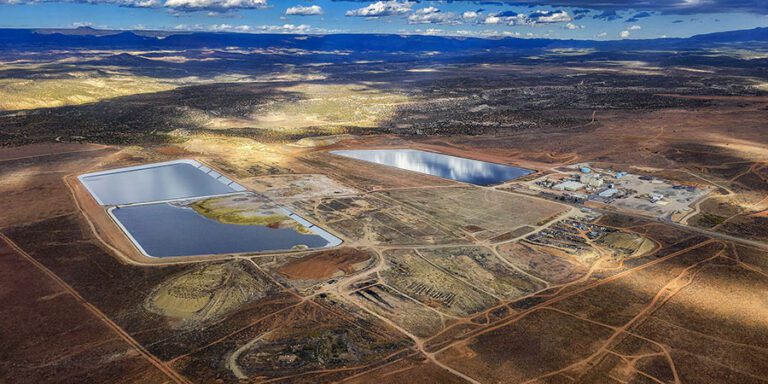
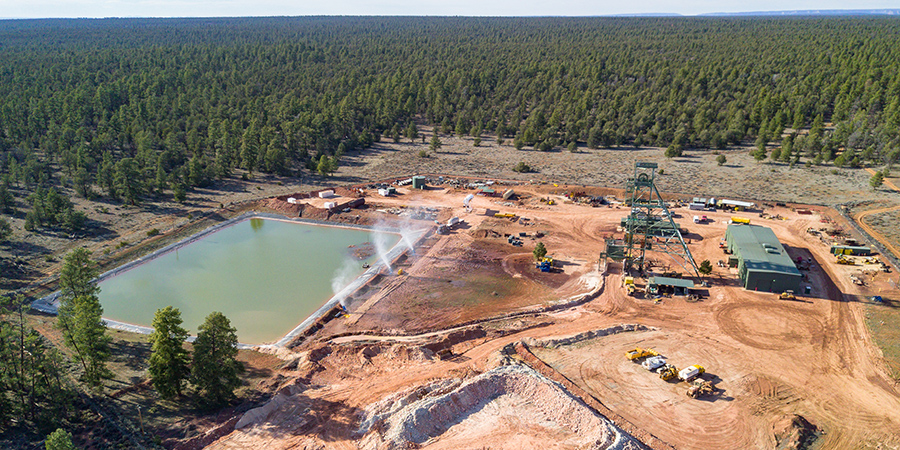
Those 80 million gallons of water have been pumped into an uncovered pond inside the mine’s chain-link fence. It’s often the only surface water for miles, so wildlife and birds are attracted to it. At times, even larger animals like coyotes have successfully breached the fence. To aid evaporation, the mine owner regularly mists the contaminated water into the air.
Levels of uranium, arsenic, and lead rise sharply
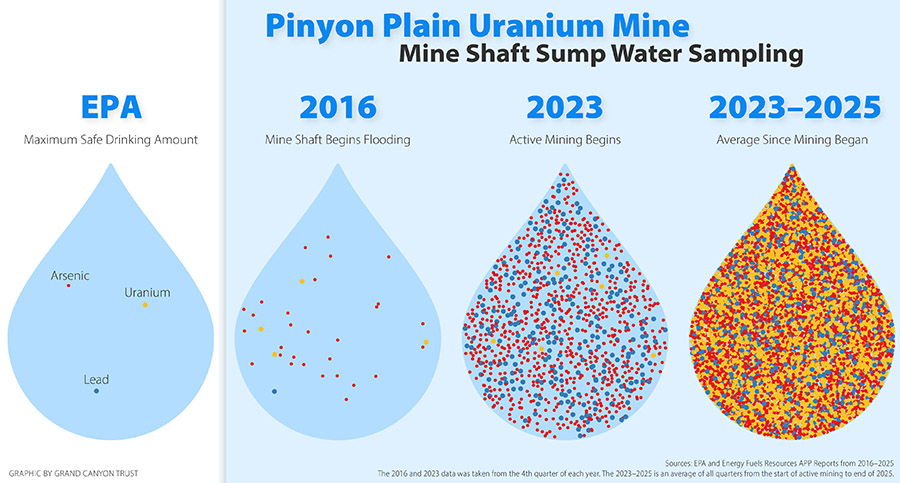 The 2025 data also shows an unsurprising, continuing pattern of rising levels of dangerous contaminants, including uranium, arsenic, and lead, especially since the mine began extracting uranium ore in 2023.
Back at the end of 2016, when the need for constant water management first started, water pumped out of the sump at the bottom of the mine shaft had lead levels at the EPA safe drinking water level, while uranium levels were four times and arsenic levels 29 times the safe drinking water level.
Fast-forward to the end of 2023, when mining began. The arsenic levels jumped to 812 times the safe drinking water limit. Lead hit 243 times, and uranium six times.
Looking at 2023-2025, the numbers continue to climb, with arsenic at 3,443 times the safe limit, lead 593 times, and uranium a whopping 3,040 times.
Why is groundwater pumping a concern at Pinyon Plain Mine?
While some animals manage to drink this contaminated water out of the pond, humans of course know better than to drink water pumped from a mine sump. And it’s no surprise that as mining ramps up, the contaminant levels in the water in the mine’s sump (at the bottom of the mine shaft) would go up too as the water encounters exposed minerals. So what exactly is the problem?
There are a few concerns.
The mine is depleting groundwater in the Grand Canyon region
First, there’s the depletion concern. Almost 80 million gallons of precious groundwater that should have stayed in the ground have instead been drained and pumped out. And there’s no end in sight. Pumping may need to continue even after the mine closes to prevent uranium, arsenic, or other harmful minerals from reaching or spreading through groundwater aquifers.
Risks of contaminating deeper groundwater aquifers
The mine’s owner denies any risk of the mine contaminating groundwater. But scientists have found groundwater flow in the Grand Canyon region to be highly complex. According to researcher Dr. Laura Crossey, “the idea that the water flow from the surface of the Grand Canyon is somehow going to stay confined up in an upper unit is just not realistic.”
Pinyon Plain Mine sits above the deep Redwall-Muav Aquifer, which feeds seeps and springs in the Grand Canyon. The Redwall-Muav Aquifer also flows into Havasu Creek and provides the sole source of drinking water for the Havasupai people, who live in a remote side canyon at the bottom of the Grand Canyon. Tribes and others are concerned that contamination from the mine could migrate down from the mine shaft and ultimately reach the aquifer.
What does the science show about Pinyon Plain Mine and groundwater contamination concerns?
A Grand Canyon groundwater study published in 2024 found the potential for contamination from Pinyon Plain Mine to reach springs on the south rim of Grand Canyon National Park and Havasu Spring near Supai Village, on the Havasupai Reservation. The study advised that further studies are needed to better understand how water flows. It also called for additional monitoring wells at the mine to test for contaminant changes.
Dye tracer studies around and inside the Grand Canyon have shown that water can flow long distances, vertically and horizontally, in unexpected ways and sometimes very quickly.
As groundwater researcher Laura Crossey explains: “I don’t think that a reasonable response is to say, ‘let’s wait and see,’ because cleaning up an aquifer that’s kilometers deep in the earth is simply not going to happen. It’s a one-way street. What we should do is prevent the possibility that those precious places become contaminated.”
Mining company asks state regulators to raise arsenic limit
Amid community and tribal concerns about the risk of groundwater contamination beyond the mine shaft, monitoring wells are a critical tool intended to ensure any pollution that does occur is detected and managed. After years of advocacy by the Grand Canyon Trust and others, Pinyon Plain Mine now has four of them, three in the Coconino Aquifer and the mine’s water supply well, which taps the deeper Redwall-Muav Aquifer.
In January, the Grand Canyon Trust discovered that the mine’s owner had applied to amend its groundwater permit, asking the state to raise its arsenic limit for one of the mine’s Coconino Aquifer monitoring wells.
We were alarmed to learn that arsenic levels in this monitoring well had started exceeding alert limits a year earlier in January 2025 and further alarmed to see the company was asking to lower the regulatory bar in that well based on a poorly justified assumption that the arsenic increases are natural and not due to mining activities.
Two independent groundwater experts have reviewed the mining company’s application and shared their feedback with state regulators even though there was no formal public comment period. The experts urged the Arizona Department of Environmental Quality to deny the operator’s application unless and until the mine’s operator does further analysis to prove the source of the rising arsenic and assure the public that the mine’s operations are not directly or indirectly causing arsenic spikes in groundwater. We are awaiting the agency’s decision.
Does the U.S. need Pinyon Plain Mine?
No. All of the estimated 2.3 million pounds of uranium at Pinyon Plain Mine are a drop in the bucket when it comes to current U.S. uranium demand. In fact, only 1.3% of U.S. uranium reserves and estimated additional resources are located in the entire Grand Canyon region.
As Energy Fuels Resources hints that it would like to open a second uranium mine in another part of Baaj Nwaavjo I’tah Kukveni national monument, we believe it’s worth taking a hard look at what’s happening at Pinyon Plain Mine.
The Grand Canyon region’s groundwater is precious and protecting it should be among the Grand Canyon state’s top priorities.