
A mining company claims rising arsenic levels in a monitoring well at a uranium mine near the Grand Canyon are natural. Are they? And will state regulators do what the company wants?
Mining company Energy Fuels Resources wants regulators at the Arizona Department of Environmental Quality (ADEQ) to raise the limit for arsenic in a key monitoring well at Pinyon Plain uranium mine (formerly Canyon Mine).
The controversial uranium mine sits just south of Grand Canyon National Park and inside the boundaries of Baaj Nwaavjo I’tah Kukveni – Ancestral Footprints of the Grand Canyon National Monument, near the Havasupai Tribe’s sacred mountain, Red Butte.
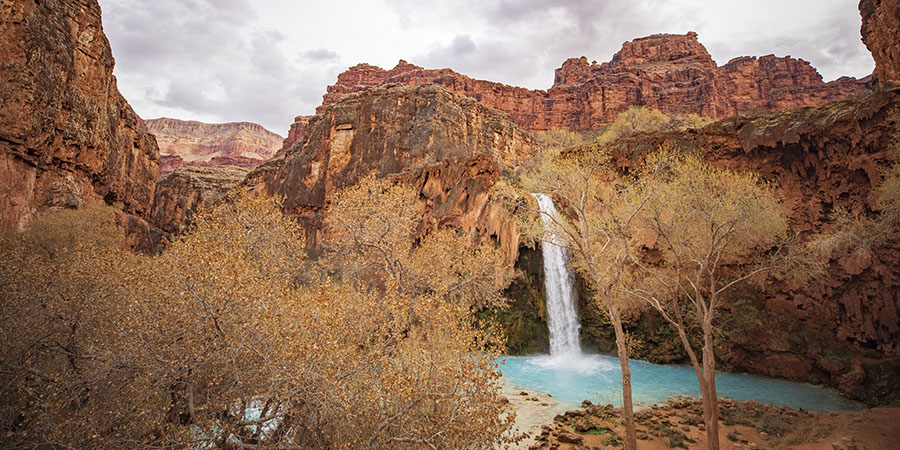
The mine sits above the Coconino Aquifer and the much deeper Redwall-Muav Aquifer, which feeds springs in the Grand Canyon as well as the iconic blue-green waterfalls of Havasu Creek. The Redwall-Muav also provides the Havasupai people’s drinking water.
What is causing the rising arsenic levels at Pinyon Plain Mine?
In November 2025, Energy Fuels applied to amend its aquifer protection permit at Pinyon Plain Mine. The amendment request seeks to increase the limit on arsenic for one of the mine’s monitoring wells — well 2, where arsenic levels are on the rise.
The increasing arsenic levels put the company over its limit. To get back in compliance with its permit, the company is asking to raise the threshold. The company based its request on the claim that the arsenic increases were naturally occurring.
Since 2016, the mine has pumped more than 80 million gallons of groundwater out of the mine shaft. The company suggests that doing so has changed the flow of groundwater and caused groundwater with high levels of arsenic to flow into the monitoring wells from outside the mine site. But does the science back this up?
Experts say more research is needed to figure out where the arsenic is coming from
Because ADEQ originally classified the amendment request as “minor,” there was no public notice and no opportunity for the public to comment. But when we forwarded the amendment to Dr. Brad Esser, a retired staff scientist at Lawrence Livermore National Laboratory, he decided to dig into it anyway. His technical comments were sent to ADEQ in March 2026. In them, Dr. Esser argued that the company’s analysis was not enough to prove its theory about the origin of the arsenic increases.
There are currently three monitoring wells inside the mine boundary drilled into the Coconino Aquifer. They were drilled after years of advocacy by the Havasupai Tribe, the Grand Canyon Trust, and others.
Monitoring wells are an important way to track water quality, detect contamination, and protect groundwater and public health. Unfortunately, the monitoring wells at Pinyon Plain Mine only began collecting data in 2021, nine years after mine development had resumed and five years after the mine shaft started taking on millions of gallons of groundwater.
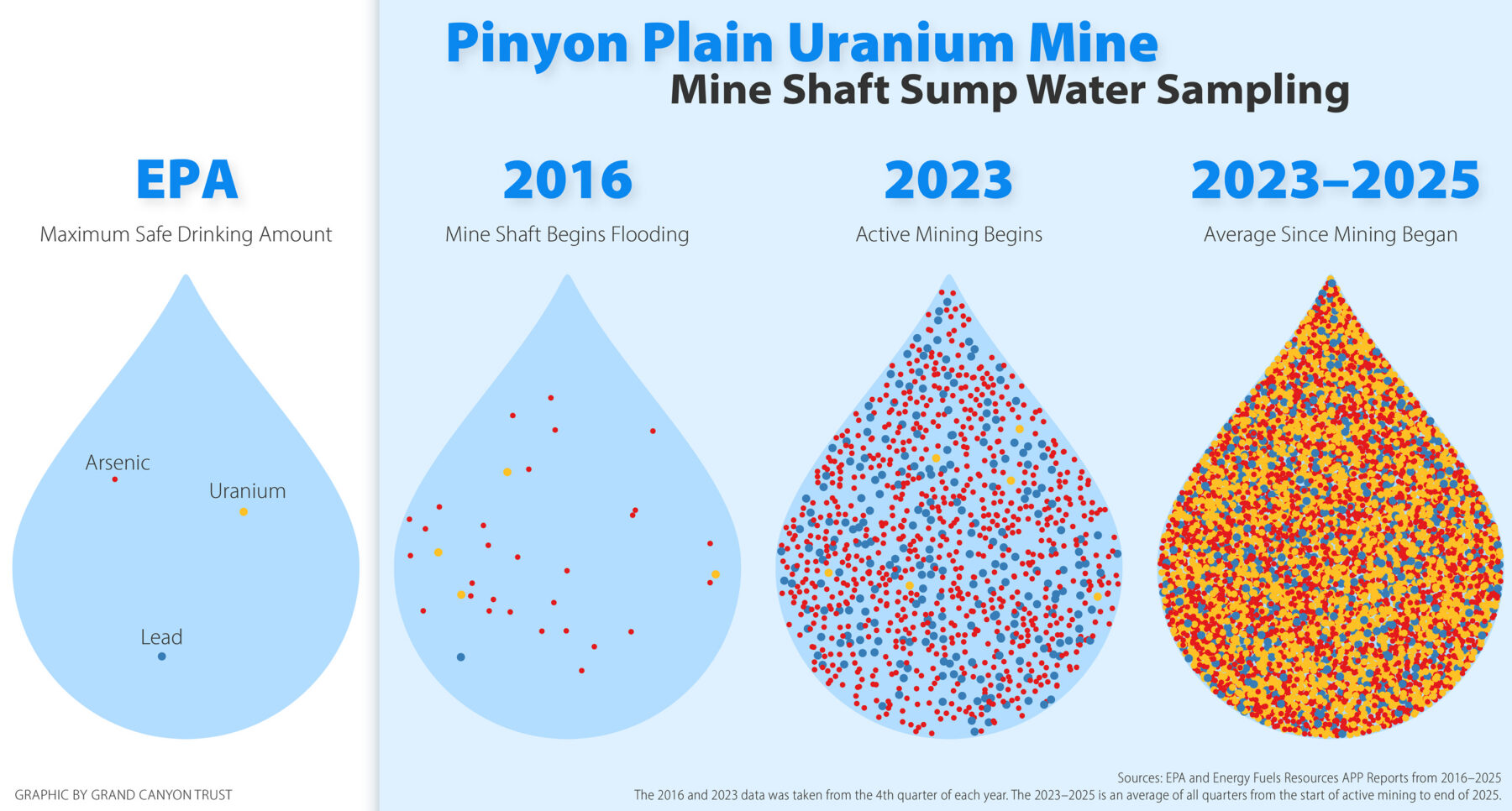
Meanwhile, arsenic levels in the mine’s sump have skyrocketed since the mine began extracting uranium in 2023. Could the mine be causing pollutants like arsenic to increase in surrounding groundwater? The complex hydrogeology of fractured rock beneath the mine is poorly understood, so it’s important that thorough analyses are undertaken.
Havasupai Tribe, local and federal elected officials raise concerns
Tribal, local, and federal government officials have all raised concerns about increasing the arsenic limit in monitoring well 2.
According to a statement from Havasupai Tribal Chairwoman Melinda Yaiva, “The Havasupai Tribe first learned of the proposed amendment, which appears to have been a private deal between ADEQ and Energy Fuels, only after a concerned citizen discovered this new amendment on ADEQ’s website and promptly notified the Tribe. The Tribe then conducted its own review and immediately recognized critical issues with ADEQ’s actions.”
The tribe is asking the public “to join the Havasupai Tribe in letting ADEQ know that attempting to sneak an amendment by the public, which diminishes environmental regulations and allows for greater pollution of our limited groundwater, is not acceptable. We should all expect more from ADEQ in protecting our precious water resources that benefit not only the Havasupai Tribe but all citizens of the of the State of Arizona.”
Representative Adelita Griljalva, D-AZ, sent a letter to ADEQ stating, “We cannot allow regulatory standards to shift in response to contamination without first understanding its cause. Doing so risks creating a situation where compliance is adjusted to fit worsening conditions, rather than preventing those conditions from occurring in the first place. That approach undermines the very purpose of environmental safeguards.”
And the Coconino County Board of Supervisors has urged ADEQ to “carefully evaluate the scientific evidence regarding the source of the elevated arsenic concentrations before making a final determination.”
On June 23, 2026, after pressure from the Havasupai Tribe and many allies, including the Grand Canyon Trust, the ADEQ announced it would treat the amendment as an “other” rather than a “minor” amendment. That requires public notice, but affords no formal opportunity for the public to weigh in. Still, the June 23 public notice seems to indicate that ADEQ is inclined to approve the mine operator’s request.
What do rising arsenic levels mean for the future?
Raising arsenic thresholds in monitoring wells so that a company can remain in compliance with its permit opens the potential that the mine will be held to a looser standard when it closes. Groundwater contamination is very difficult, if not impossible to clean up. The mine could leave the site with worse water quality than before.
As the Havasupai Tribe reminds us, “Arsenic is a highly toxic element known to cause cancer and other health issues.” Increasing pollutants in groundwater beneath Pinyon Plain Mine is a problem, whether it’s because the mine mobilized them by altering groundwater flow or because the mine directly discharged pollutants. ADEQ should hold the mine owner accountable.