
How much Colorado River water flows through the Grand Canyon? A new set of rules for the river will decide.
The Colorado River is about to get a new set of rules for its two largest reservoirs — Lake Powell and Lake Mead. These rules aim to bring water uses more in line with the river’s dwindling water supply. But they will also determine everything from how much water flows through the Grand Canyon, to where and how much electricity can be generated, to how much water tribes, cities, and farms receive.
On January 9, 2026, the U.S. Bureau of Reclamation laid out options for what these rules could look like. The agency detailed, in five different alternatives, rules for determining how much and under what conditions water from the upper basin states (Colorado, New Mexico, Utah and Wyoming) would be released from Lake Powell to Lake Mead each year.
Lake Powell releases through Glen Canyon Dam make up 92% of water flowing through the Grand Canyon. How much water flows through the dam into the Colorado River directly impacts plants, animals, beaches, cultural and archaeological sites, and other important resources in the Grand Canyon.
Five choices for the Colorado River
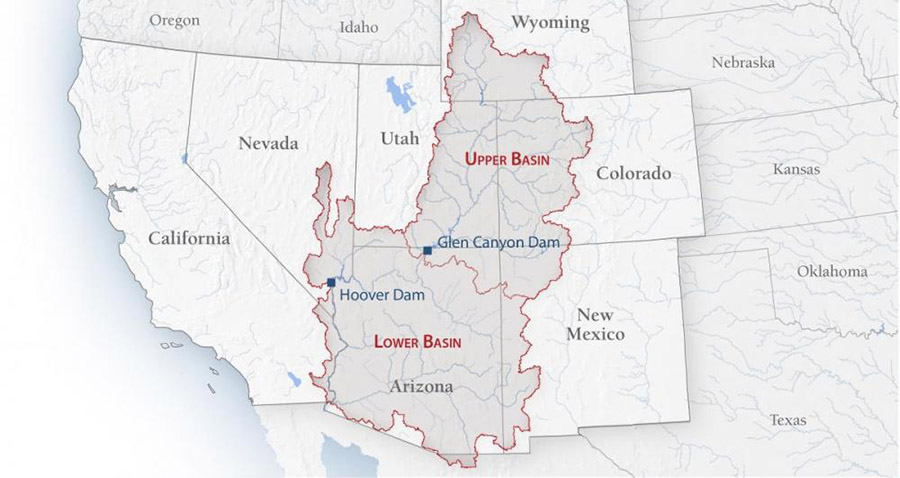
The new Colorado River rules will determine if and by how much the lower basin states (Arizona, California, and Nevada) need to reduce their water use below the amount promised to these states 100 years ago to balance supply and demand. The rules will also determine if and how much the upper basin states need to contribute.
Two of the proposed choices, called the “no action” and “basic coordination” alternatives, can be implemented without the seven basin states reaching an agreement. These options, however, do not address the underlying issue — that water use is outpacing water supply. This imbalance is causing both Lake Powell and Lake Mead to fall to critically low water levels under dry conditions.
Of the remaining choices, the “enhanced coordination” and the “maximum flexibility” alternatives do a better job of addressing the supply-demand imbalance when it’s dry. But these, in addition to the “supply driven” alternative, would require a deal between the seven Colorado River basin states. After years of negotiation, such a deal remains elusive.
The public has until March 2, 2026 to weigh in. Take action now
Why are new Colorado River rules necessary?
Two reasons. First, the current 2007 guidelines expire at the end of 2026. Second, flows in the Colorado River over the past 25 years have declined significantly. The dwindling water supply has drained Lake Powell and Lake Mead to dangerous levels. Without new rules to address the growing gap between water supply and demand, the communities, cultures, wildlife, and economies that rely on the Colorado River won’t be able to survive.
Who is involved in creating the post-2026 rules?
There are a lot of stakeholders at the table in creating the post-2026 guidelines for managing the Colorado River. These include the U.S. Bureau of Reclamation, the seven Colorado River Basin states (Arizona, California, Colorado, New Mexico, Nevada, Utah, Wyoming), the 30 basin tribes, non-governmental organizations, farmers, ranchers, cities, and recreational users, among others.
How are the new rules being developed?
Two ways. First, the seven basin states and the federal government are negotiating the new rules behind closed doors. The 30 basin tribes have been excluded from these discussions. The crux of these negotiations is who will have to reduce their water use from what was promised 100 years ago. Unfortunately, there simply isn’t enough water in the river for every state to get what was originally allocated. And the states still haven’t been able to reach a deal.
Second, the Bureau of Reclamation is nearing the end of a three-year process under the National Environmental Policy Act to analyze a range of scenarios for managing the Colorado River. The agency is hoping for a deal between the states to help inform what a “preferred alternative” might look like. A preferred alternative could be one of the five alternatives it analyzed, or a mix-and-match approach. Without a state deal, the Bureau of Reclamation will have to find a path forward for the basin alone.
Now, this is where you come in. This is a key time to weigh in to protect the Colorado River, especially as it flows through the Grand Canyon. The deadline for public comments is Monday, March 2, 2026.
How can you take action to protect the Colorado River?
Reclamation is taking comments on the draft plan. Please urge the agency to:
- Commit to manage the Colorado River and its resources sustainably. This is key to protecting the Grand Canyon’s resources.
- Follow the Grand Canyon Protection Act of 1992. The act mandates that releases from Glen Canyon Dam protect and improve the cultural and ecological values of Glen Canyon National Recreation Area and Grand Canyon National Park.
- Commence a comprehensive study of Glen Canyon Dam infrastructure. A study is needed to ensure that the dam’s design does not prevent adequate flows from being released through the dam as critically low water levels become the norm.
- Maintain Lake Powell water levels above 3,525 feet. This ensures that high-flow experiments, which protect the Grand Canyon’s ecology, can continue. You can check Lake Powell’s current water level here
- Until a physical barrier is built to prevent non-native fish from passing through the dam, prioritize keeping Lake Powell above 3,540 feet. This prevents non-native fish passage and protects native species like the humpback chub.
- Commit to continue cool water releases through the dam to maintain temperatures that discourage non-native fish reproduction. If cool releases can’t be maintained, keep Lake Powell at higher elevations around 3,570 feet.
- Ensure that Glen Canyon Dam releases accommodate the need for variable high and low flows in the canyon. But limit steady high-volume releases to avoid eroding too much sediment from Marble Canyon and the Grand Canyon.