Colorado River is top employer in Southwest U.S. and major economic driver

“The Colorado River is the economic, cultural and social backbone of the Southwest. This is true for recreational uses of the river as well, as today’s report clearly demonstrates.” — U.S. Senator Mark Udall

Following extensive research into the economic impact of recreational activities along the Colorado River and its tributaries across six western states, Protect the Flows in partnership with Southwick Associates, Inc. today released a study, “Colorado River, Inc.: The $26 Billion Recreation Resource Employing a Quarter Million Americans,” revealing the Colorado River to be the 19th largest employer on the Fortune 500, and major economic powerhouse fueling economies in Arizona, Colorado, Nevada, New Mexico, Utah, and Wyoming.

Protect the Flows, a coalition of more than 400 small businesses from the seven Colorado River basin states of Arizona, California, Colorado, Nevada, New Mexico, Utah, and Wyoming, commissioned the report by economic research firm Southwick Associates, Inc. to understand the economic output derived from the Colorado River and its tributaries. The study found that 5.36 million adults use the Colorado River and its tributaries for recreational activities, including picnicking, trail activities, wildlife watching, camping, fishing, water sports, bicycling, and snow sports each year, and that such recreation, in turn, contributes significantly to the economic growth and stability of basin region states.

Among the study’s key findings, river-related recreation in the six-state region: – Supports 234,000 jobs across Arizona, Colorado, Nevada, New Mexico, Utah and Wyoming – Produces $26 billion in economic output – Generates $17.0 billion in retail sales – Out performs regional farming revenues by 14.6% onaverage – Contributes $3.2 billion in federal, state, and local tax revenue annually – Provides enough state and local tax revenues to fund over 29,000 teacher positions – Creates $10.4 billion in annual earnings, salaries, and wages

“The Colorado River is a major provider of recreation, which is a tremendous economic driver across the basin region. But what must be emphasized here, is that unlike other income generators, there are very few substitutes for the Colorado River,” said Rob Southwick, the study’s lead economist. “Typically, there are alternative places for people to visit and spend their money when their preferred recreation spots no longer usable. However, consider the size of the Colorado River basin and the distance to alternative places, well over half the people surveyed said their outdoor recreation would significantly decrease if the River was not available. Without recreation along the River, the federal government is risking over half a billion dollars in taxes.”

The study comes as the Bureau of Reclamation (BOR) considers proposals to resolve the supply and demand imbalance during the final weeks of the Options and Strategies Phase of the Colorado River Basin Study. Upon completion in July 2012, the BOR Study will define current and future imbalances in water supply and demand in the Colorado River Basin over the next 50 years, and will provide adaptation and mitigation strategies to resolve those imbalances. The federal and state governments can then consider these findings when deciding on measures to implement to solve the imbalance.

“This study makes it clear just how much the Colorado River needs to watch its bottom line. Water-related recreation is our lifeline,” said Protect the Flows coordinator Molly Mugglestone. “The West’s economic future is tied this magnificent resource and the recreation it encourages, so we would do well to do all we can to protect it and keep the river flowing.”

U.S. Senators Mark Udall (D-CO) and Michael Bennet (D-CO) are encouraged by the numbers and will meet with the study’s lead economist and mountain region business leaders on Friday, May 4, in Denver to determine what actions they need to take to preserve the future of the Colorado River and its associated recreation and tourism economy.

“When tourists visit the Colorado River, they’ll stay in a hotel, eat out at restaurants, fill up their gas tank, maybe buy snacks and souvenirs,” said U.S. Senator Bennet. “When you consider all these visitors, it all adds up to billions of dollars that ripple through our economy.”

“The Colorado River is the economic, cultural and social backbone of the Southwest. This is true for recreational uses ofthe river as well, as today’s report clearly demonstrates,” said U.S. Senator Udall.  “We must be mindful of the important role outdoor recreation plays in our economy and to our way of life as we make decisions about how to allocate water, because we stand to lose thousands of jobs and billions of dollars in Colorado if we do not.”

For the complete report, go to http://protectflows.com/creating-jobs/.

Share
Posted in Grand Canyon Issues | Leave a comment

Civil Society Institute survey shows vast majority of Americans are ready to move toward clean, renewable energy

Americans and Energy Policy: The Myth of the Partisan Divide

Salt River Project wind towers in NE Arizona

Recently, the Civil Society Institute released new survey results that show that the vast majority of Americans are not only ready to grapple with tough energy choices, but also to move toward clean, renewable energy. These results underline the fact that a simplistic, “all of the above” strategy that includes nuclear power, coal, and unconventional (or “fracked”) shale gas is not what the majority want.

Americans realize the damage being done by dirty fuels and nuclear power, and are ready and able to make tough choices. It’s time for politicians to start to listen and start making some decisions as well.

Here are some of the highlights from the survey:

- More than eight out of 10 Americans (83 percent) – including 69 percent of Republicans, 84 percent of Independents, and 95 percent of Democrats — agree with the following statement: ‘The time is now for a new, grassroots-driven politics to realize a renewable energy future. Congress is debating large public investments in energy and we need to take action to ensure that our taxpayer dollars support renewable energy– one that protects public health, promotes energy independence and the economic well being of all Americans.”

- Even with high gasoline prices today, 85 percent of Americans – including 76 percent of Republicans, 87 percent of Independents, and 91 percent of Democrats — agree with the statement “(e)nergy development should be balanced with health and environmental concerns” versus just 13 percent who think “health and environmental concerns should not block energy development.”

- More than eight out of 10 Americans (82 percent) – including 78 percent of Republicans, 81 percent of Independents, and 85 percent of Democrats — agree with the following statement: ‘Whether they are referred to as ‘subsidies,’ ‘tax incentives’ or ‘loan guarantees,’ the use of taxpayer dollars for energy projects are long-term investments. However, government incentives for energy must benefit public health and economic well-being. Clear guidelines are needed to direct public energy investments by shifting more of the risk from taxpayers and ratepayers and more to the companies involved.’”

Click here for the full survey results.

Click here for more information on CLEAN.

Share
Posted in Arizona Issues, Plateau-wide Issues | Leave a comment

Celebrating Arizona Rivers: The Salt River

River of the Month Series: April 2012

Celebrating Arizona’s Rivers

Each month during Arizona’s centennial year, we will profile a different river in celebration of the state’s precious natural resources. From the mighty Colorado to the smallest ephemeral streams, these waterways have supported Arizona’s people and places for thousands of years. With good stewardship and thoughtful planning, they will continue to flow into Arizona’s next 100 years.

Featured river for April 2012: Click on Salt River

Arizona’s Salt River Celebrated

Arizona “River of the Month” Series Launched to Celebrate Arizona Centennial

Salt River along Apache Trail below Roosevelt Lake Photo by Richard Mayol

(Phoenix, Ariz.—May 4, 2012) Five conservation groups this week celebrated the Salt River as their second“River of the Month” in a year-long series honoring the Arizona Centennial. The series features fact sheets with graphics and photos profiling the geography, ecology, use, and threats to a different river every month to celebrate the Arizona’s precious waterresources. Last month, the groups focused on the Colorado River as the “lifeblood of the West.”

“If the Colorado River can be said to the ‘lifeblood of the West,’ the Salt River is the lifeblood of Phoenix and the surrounding communities,” according to the profile by Environmental Defense Fund, Sierra Club, Grand Canyon Trust, Sonoran Institute, and Western Resource Advocates, the groups behind the river series.

The story of the Salt River is symbolic of the many faces of Arizona, from the river’s journey through a rugged and spectacular canyon wilderness to its essential role in cultivating the farms, industries, and development that gave rise to Phoenix, the sixth largest city in the U.S., in the unlikely landscape of the Sonoran Desert.

From its origin, the Salt River flows west through Native American lands and a remote wilderness area, then through a series of dams and reservoirs that provide water and power to the Phoenix metropolitan region.The first and largest dam, Roosevelt, completed in 1911, created Roosevelt Lake and secured a reliable water supply for Phoenix. Below Roosevelt Dam, the Salt flows through three more dams and reservoirs and is then joined by its largest tributary, the Verde River, from the north. Below this confluence, the Granite Reef Diversion Dam distributes water to canals that flow to the Phoenix metropolitan area. Due to these diversions, the Salt now rarely flows below Granite Reef and along its course through Phoenix.

Various efforts to restore degraded stretches of the Salt River are underway. For example, within the City of Phoenix, the Rio Salado Habitat Restoration Project utilizes urban runoff and groundwater to restore a five-mile stretch of riverbed. Completed in 2005, the restoration area provides environmental education and economic development opportunities along a revitalized riverbed. Such projects “point the way to what is possible when people recognize that Arizona’s rivers are an ecological and economic asset to the people of the state,” said EDF’s Jocelyn Gibbon.

The next river featured by the groups will be the Little Colorado River. The University of Arizona’s Water Resources Research Center (WRRC) has provided assistance in preparation of the profiles. The WRRC’s recent “Environmental Water Needs Assessment” evaluates information about the water needs of environmental resources in Arizona.


Share
Posted in Arizona Issues | Leave a comment

Enjoy archaeology? A letter from our friends at Colorado Plateau Archaeological Alliance

Dear Grand Canyon Trust members and friends,

I am contacting you to let you know about the Colorado Plateau Archaeological Alliance’s new website, www.cparch.org, our new Facebook page, and our summer plans.

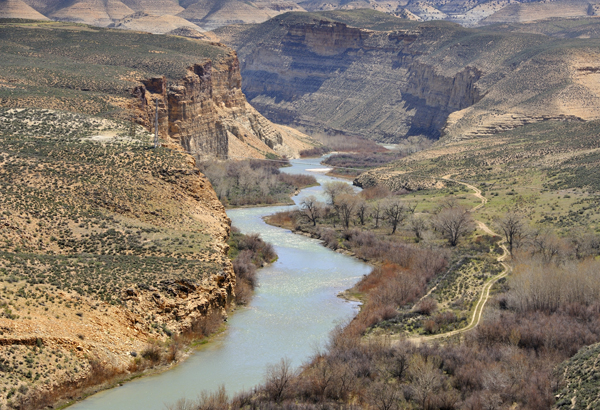
Desolation Canyon by Ray Bloxham

The Alliance is a nonprofit organization based in Utah, whose unique mission is to protect sites throughout the Southwest. In late July, CPAA is doing a week-long river boat survey in central Utah down the Green River through Desolation Canyon, and I was wondering if you might be interested.

For a $1,000, all expenses paid, tax-deductible donation, you can join a team of archaeologists and volunteers on an unforgettable expedition through some of the wildest parts of the state. There are some phenomenal sites along the Green River, as you may know, and part of CPAA’s mission is to document them.

Desolation Canyon is one of the remotest areas in the Lower 48, and one of the least-disturbed. If you want to see a landscape virtually untouched by human contact over the past 800 years, this is one place that easily fits the description. Should you have any questions about the trip or suggestions on who else might be interested in joining us, please get in touch with Executive Director Jerry Spangler (801-392-2646; jerry_cpaa@comcast.net) or me (my cell # is 239-826-6734). I would like to hear what you think of our new website, and I’d encourage you to visit our Facebook page as well.

We have a lot of exciting projects that Grand Canyon Trust members and friends would be interested in, including expeditions in Nine Mile Canyon (written about extensively in Spangler’s book Horned Snakes & Axle Grease), the Kaiparowitz Plateau, and Range Creek.  Thanks a lot.

Hope to hear from you soon.

Mark Russell Sanders
Outreach Coordinator
Colorado Plateau Archaeological Alliance
2529 Jackson Ave.Ogden, UT 84401
(239) 826-6734 cell

www.cparch.org
http://coloradoplateauarchalliance.wordpress.com

Share
Posted in Other News, Volunteers | Leave a comment

A Just and Healthy Future for the 100%

Bill Hedden Executive Director, Grand Canyon Trust

Three years ago I asked a neighbor’s grown daughter why the food security movement struck such a chord with young people these days. She answered simply, “Because we know that you guys aren’t going to do anything about climate change, and when everything falls apart we want to be able to feed ourselves.”

Of course, in those days, we believed that the Congress would surely pass legislation to curb our domestic carbon emissions, and somehow international agreements would pull us out of a planetary climate nosedive. But the intervening years have shown us that my neighbor’s daughter was right: America set 130,000 new all-time records for heat, drought and floods last year, yet as the weather gets wilder a majority of us tell pollsters that we don’t believe climate change is a problem. With February temperatures into the 80s in Chicago and murderous tornadoes striking Illinois and Michigan during months that used to be winter, we watch a presidential campaign where nobody will even mention the fate of the diaphanous atmosphere that is the only thing protecting us from the howling universe outside.

These are hard things to think about. The worst predictions you have ever heard about climate change still factored in forceful action to reduce emissions. Yet, we look away from the enormity of the threat and the changes that must be worked in our lives if we are to respond. Give us a fig leaf of deniability and we will pretend it’s just going to get a little hotter and people may have to sandbag their beach houses. And so the corporations and ideologues oblige us with their campaign denying climate change, and we gratefully keep our heads in the sand.

I am not setting myself apart here. I have a good grasp of how much about my life must change and I’ve done almost none of it. But a series of conversations with young people has awakened me to dimensions of this crisis that I did not understand, ultimately bringing me before you today to give a talk that, frankly, dismays me.

It began with a group of astonishingly bright college students tasked with studying the future of the Colorado River for an international symposium on freshwater resources in a changing climate. One of them asked me what I think of climate models that show a 15% decline in precipitation over the basin within the next 30 years. I said that my modest understanding of chaotic systems leads me to believe that if you just keep pumping in more energy they will eventually fly off into a different equilibrium where the new normal could easily be an unlivable disaster.

I felt terrible for a moment, having managed to give an answer that was both dark and trivial, and then I saw the five students exchange a look that was not meant for me. It was a look that said that they knew all this far better than I, and had thought far worse, and they were bemused by having somebody of my generation actually fess up to the problem. It was a look that said, “We are building our lives in the shadow of this looming reality that you guys have created and are doing nothing about.”

That first insight led to many subsequent conversations in which I entered a world where our children look at a future of catastrophe, wondering how they will feed themselves and organize a society…a world where we have become, at best, irrelevant through our inaction…a world where they have taken to the streets protesting the broken, corrupt politics we have made…and I fear that we are opening up the widest, most painful gulf between generations that one can imagine. Either young people have checked out from despair, or their thought has shifted to dealing with the coming storm that is our legacy to them.

My daughters have grown used to having Dad cry silently and for no reason when I hug them; or when I look at the beautiful deer and foxes and other wildlife in our yard. About a third of the species on earth are expected to go extinct in the chaos and these innocents simply break my heart.

Today’s world requires that we hold two images in mind at once: an unflinching view of the tragedy and loss beginning to unfold on our present course; and a vision of an unprecedented joining together to save ourselves, using all the resources of technology and love available to us.

So I will spend a few minutes giving snapshots of the world we are in, where the hour is far later than we normally allow ourselves to understand. And then I will talk about what we might begin to do, together with our children, because being heartbroken can either flatten us or give us the fierce courage and joy we will need to do the thousand things necessary to choose a different future.

As I’m sure you know, scientists now consider 350 ppm of atmospheric carbon dioxide as the level beyond which warming becomes dangerous. A recent lead article in Nature says “beyond 350 ppm we threaten the ecological support systems…and severely challenge the viability of contemporary human societies.” Unhappily, we are now above 390 ppm and worldwide greenhouse gas emissions are rising faster than ever before recorded.

We get numbed by numbers. How bad could a few degrees really be? Well, a few degrees are already changing atmospheric circulation so that Australia’s wet westerly winds are veering south to dump their rain over the ocean. The land is in permanent drought. In January 2009, a record heat wave struck South Australia, buckling rail lines like spaghetti, infesting stagnant reservoirs with algae, and blowing out power to Melbourne. Across the city, on the hottest day ever recorded there, the internet went down, air conditioning stopped, people were stranded in elevators, hospitals were without power, and all the traffic lights went out, trapping emergency vehicles in gridlock. Rioting broke out within hours before the power was mercifully restored. The next week, the Black Sunday bushfires sent four story high walls of flame racing across the land, killing 175 people. Prime Minister Kevin Rudd said, “Hell and its fury have visited the good people of Victoria.”

Every day, with our thick new atmosphere, the earth soaks up about 400,000 Hiroshima bombs more energy than it radiates back into space. So, ever since 2007 the Arctic ice cap has been more than a million square miles smaller than normal. Santa’s elves and the polar bears treading the open waters more than 50 years ahead of predictions. In the last five years Greenland’s ice melted more than a trillion tons. And temperatures on Antarctica are rising 75% faster than a decade before, faster than anywhere else on earth. Sea levels are expected to rise by 6 feet during this century, drowning nearly every rice-growing river delta in Asia, and inextricably linking the fate of the hundreds of millions who depend on the rice to the fate of the far away ice sheets.

Rising seas greatly amplify the damage from big storms, and storms are getting much bigger. Atlantic Hurricanes have increased 75% over the last decade. They are stronger and don’t die out on making landfall. Typhoons in Bangladesh have increased 400%, flooding the dwellings of a hundred million people in 2006. Typhoon Marakot dumped nine and a half feet of rain on Taiwan in 2009. The New York Times reports that “the last thirty years have yielded four times as many weather related disasters as the first three quarters of the 20th century combined.”

Temperatures in the Himalayas are rising by a degree every decade, or about the amount of variation since before the invention of agriculture 10,000 years ago. The ice sheet that provides drinking and irrigating water for billions downstream in China and India has lost 300 vertical feet of ice since the Mallory expedition took the first photos in 1921. Early this year the National Academy of Sciences reported that comparatively modest climate change in the past has routinely destabilized civilizations, through drought, famine and disease. The study notes that today’s societies are better resourced, but more dependent on infrastructure, more densely populated, and more vulnerable. With the world’s hungry already numbering more than a billion, the melting of the Himalayan glaciers presents the biggest challenge to food security humanity has ever faced.

Closer to home, the disappearance of snowpacks in the Rockies and Sierras threatens water supplies for 75% of the population in the western U.S. There is a 50-50 chance that Lake Mead will run dry in the next 8 years, prompting Pat Mulroy, of the Southern Nevada Water Authority to observe, “You cut off supply to the fifth largest economy in the world.” And with the breadbasket of the US Great Plains now facing chronic drought, it may not be as easy as we always thought to transfer water from agriculture to thirsty cities.

The Colorado Plateau, where I live, is in the climate bullseye, projected to get at least 8 degrees hotter this century. Rising temperature bakes the moisture out of the soil and throttles photosynthesis, and even most desert plants cannot adapt. Native grasses will be extirpated from the region within 30 years, taking the habitat for the rabbits and mice, which feed the coyotes and snakes and foxes and raptors. That is what it means to wreck the base of the food chain. The plants also help hold the land together, protecting against the massive dust storms that cover the snowpack in the dreaded dark blanket that sends the water flooding off the hills six weeks early, confounding irrigators and exposing the soils to further desiccation.

Everything I have described is already underway in what we might now call garden variety climate change. Without massive action, most scientists believe we are headed toward atmospheric CO2 of at least 650-700 ppm, levels where the fossil record shows that delicately named non-linear scenarios kick in. I will close this depressing catalogue with just one of these horrors.

Near the poles, where things are happening fastest, the potent greenhouse gas methane exists in immense quantities in frozen tundra. Temperatures over the region have risen 10 degrees in the last decade and researchers are discovering methane chimneys rising from the permafrost, further warming the air. If that really gets going it will feed on itself and the permafrost could release the equivalent of 270 years of current worldwide CO2 emissions with no further help  from us……and that is not dystopian science fiction; it is just what our planet does when the atmosphere gets this far out of whack. As I said, these are hard things to think about, but do we really mean to ignore them completely?

We know all this, and we know that someday we will have to do something about it. The problem is in knowing where to start and in deciding that today, now, is the time.

Once you’ve laid out the global dimensions of the problem, all the possible solutions seem puny in comparison…It is really tempting to hope for some grand international bargain on emissions, but that isn’t going to happen within any meaningful timeframe…unless we all decide to change things. In this hyper-connected world, it may not be possible for politicians to lead anymore; but they can follow. Imagine how quickly both parties would jump on this if polling showed that 75% of us thought saving the planet was a top priority.

So, for each of us, starting small and close to our hearts is the key, partly because we know the issues and partly because the essential insight is that there are innumerable portals to exactly the kind of response that is needed. The human scale, that is the only one open to us, is also the only scale that will make a difference…multiplied by 7 billion. According to Desmond Tutu, God says to each of us, “The only one I have is you.”

The answers usually aren’t complicated, and generally people are already working on them. In my field, imagining an arid West beset by climate chaos, we must first protect the aquifers and watersheds as they will be the most essential things and deeply threatened. Likewise, the functioning of the biggest wild places must be preserved, restored, and linked where possible, to serve as carbon sinks, water filters, and refuges for the wild creatures who will be pushed to the brink, and without whom we will go mad. In each place, we need to determine the parts of the landscape that hold the world together and then defend them as if our lives depended on it.

The real question here, as in so many other areas, is the social one of how we will accomplish these simple acts of sanity with the urgency we might feel if we could actually see the droughts, roaring fires, tornadoes and floods coming down over the Flatirons. How indeed, when today we struggle for years on end to win protection for each bit of stream or forest or grassland? We need to ask ourselves what the conservation community has to look like to get this fundamental work done in real time.

There are obvious alliances we must forge with recreationists and farmers and sportsmen. We really don’t have the luxury of defining our interests and parsing our differences so finely any more. This will be easier if we make conservation simple again, holding the vision of a networked landscape, but keeping the work local and embracing the chaos of many constituencies.

And, of course, our children are the most irreplaceable allies of all. They are keen observers and networked like nothing the world has seen before… And when you get on to these subjects, the next generation might be motivated and react in ways we scarcely imagine. The key is to meet them where they are, already quietly figuring out how to share life-preservers while we keep rearranging deck chairs. The title of my talk, “A Just and Healthy Future for the 100%” comes from the Salt Lake climate action group Peaceful Uprising and exemplifies the inclusive, all for one and one for all, approach of people who know there might not be enough lifeboats.

Understandably, the next generation has tended to focus on recreating our communities and our systems for producing food and power so that they are distributed, equitable, climate friendly and durable in the face of the rough times ahead. We have much to learn from them, and perhaps something to contribute.

Here again, the work is right in front of us, whether your propensity is to start a farmer’s market or don gas masks and walk the halls of Congress as part of the Beyond Coal Campaign. Others may have the training to lead the technological revolution in transportation and green energy foreseen by visionaries like Amory Lovins, or the compassion to work with the world’s poorest and most vulnerable people. Perhaps, if you know any smart, young lawyers, they might bring a precedent-setting case on Black Swan events or something else that could change the landscape like David Getches’ Boldt Decision did.

I believe that a lot of the stress and malaise in our country today arises because we know we are in trouble and we are making ourselves crazy by whistling past the graveyard. It would be an enormous relief to admit, as a society, the challenge we face and start doing something about it. In the end, even if it becomes very difficult, remaking society into something that can endure will be the most hopeful and exciting work we could ever do to.

Let me leave you with this thought: if all the climate scientists are somehow wrong, and we take forceful action, then we will have been thriftier with our resources, cleverer with our technology, more compassionate about our fellow denizens of planet earth and more loving with our children than we really needed to be. And if the scientists are right and we have awakened a planetary geophysical wrath, where would you rather be when it hits than arm in arm with your kids and community trying to do the right thing, come what may?

~Bill Hedden

This talk was delivered at The University of Colorado Law School symposium in honor of David H. Getches: A Life of Contributions for All Time, on April 27, 2012.

It borrows heavily from several sources:  Bill McKibben’s invaluable book Eaarth: Making a Life on a Tough New Planet; Lester Brown’s (Earth Policy Institute) authoritative volume Plan B: 4.0; Mobilizing to Save Civilization; and the speeches of climate scientist James Hansen. Any errors introduced are mine.

Share
Posted in Plateau-wide Issues | Leave a comment

We need leaders to champion a clean-energy future

by Jihan Gearon – Apr. 29, 2012 06:07 PM

Navajo Generating Station emits toxic nitrous oxide plume into air over Colorado Plateau

Back in the 1960s and ’70s when many coal-burning power plants in the  Southwest were built, coal was one of a limited number of options available for  power generation.

That is no longer true. So why are we seeing so many industry and political  leaders today behaving as if it were?

Consider the Navajo Generating Station coal plant near Page that sends electricity to Phoenix, Tucson, Nevada and California, but not to much-nearer Navajo communities.

Besides electricity, the plant generates pollution — literally tons. In  addition to contaminants like mercury and lead, the smokestacks spew 25,000 tons  of nitrogen oxide a year. That, in turn, produces fine-particle pollution that  gets deep into people’s lungs and can cause heart attacks, strokes, asthma  attacks and lung cancer.

Everyone wants healthier air, and the Environmental Protection Agency is  supposed to decide soon on updated pollution controls that the aging Navajo  Generating Station needs to install to cut a lot more of its dangerous  emissions.

But industry and political leaders are shoving back hard. They’re portraying  this as a choice between healthier air or cheap water, or healthier air vs.  coal-plant jobs (that’s because gradually transitioning off coal would likely  make better financial sense given the costs of cutting coal pollution).

Like many Navajos, coal and other extractive industries were a normal part of  life for me as a child. My grandfather was a medicine man who worked in the  timber industry. My uncle worked at a coal mine. Growing up on the Navajo  Nation, it can be difficult to imagine any other way.

Difficult perhaps, but not impossible.

I work with many young Navajos today, the generation that will be tomorrow’s  tribal leaders, and it’s truly striking what a different vision they have for  the future.

The Navajo Generating Station began being constructed more than 40 years ago.  So today’s younger Navajos ask: What’s possible today and over the next 10 years  that wasn’t back when the plant was built? What are the options to generate  clean power from the sun on Navajo land? How many jobs would be created? How  much income would be generated? Could the coal plant be phased out gradually  while cleaner sources are developed? What pollution and health and water savings  would there be?

Sadly, we’re not getting anything close to this kind of analysis or forward  thinking from leaders.

Instead, the Navajo government and plant owner Salt River Project are focused  narrowly on preserving the coal status quo, and they issue one-sided reports  that never consider the plant’s pollution or health- or water-use impacts, nor  the economic benefits in a transition to other energy options. Central Arizona  Project exaggerates price impacts on pumping water, and state legislative  leaders take cover behind it all to avoid any difficult leadership.

The U.S. Department of Interior hasn’t provided leadership yet either. The  report it commissioned on the Navajo Generating Station by the National  Renewable Energy Laboratory in Colorado didn’t even look at options for  transitioning to cleaner energy. Yet, isn’t that exactly what America’s foremost  experts in renewable energy should be looking at first?

There are ways out of the “health vs. water vs. jobs” box now that weren’t  available before. We don’t have to continue to pit them against one another.

Young people today see this opportunity and want action to seize it, in part  because they’re the ones who will live longest with the consequences if we  don’t. It’s challenging, not impossible.

Don’t political and industry leaders today owe it to our younger generations  to rise to that challenge, instead of running from it?

Jihan Gearon is the executive director of Black Mesa Water Coalition, a  non-profit organization working with Navajo and Hopi youths and young  adults.

Read more:  http://www.azcentral.com/arizonarepublic/opinions/articles/2012/04/27/20120427clean-energy-future.html#ixzz1tXduUvMz

Share
Posted in Grand Canyon Issues, Native America Issues, Plateau-wide Issues | Leave a comment