Spring 2006 Portfolio
The Native American Program made major progress in its projects with Hopi and Western Navajo communities and respective Tribal government departments. This section highlights several projects that exemplify the in-depth work we are able to do with Tribes due to our ability to focus on a few projects over a longer time horizon.
Hopi - Sunshine Wind Project
 |
|
| |
© by
John Running |
With the NA Program’s assistance, this project was approved by the Hopi Tribal Council and the Coconino County Planning & Zoning Department. We assisted the Hopi Tribe and Foresight Energy with public education, third-party analysis of the project, education to Foresight about Tribal laws and customs, and business partnership concepts that enable Native communities to gain an equity stake in renewable energy projects.
The Sunshine Wind Project will create a 60 megawatt wind park with 16 of those megawatts located on Hopi fee lands, making the project the largest such project sited on Native American lands. The Trust feels that a successful project on Hopi fee lands will serve as an important business laboratory – creating a working model for site lease design, project evaluation and negotiation, tribal renewable energy capacity building, tribal community input, and tribal/developer partnership and investment. This project will enable the area’s Native American Nations to experience both the costs and benefits of a major scale wind development while providing a template for future renewable energy projects on Native American lands.
The park, originally slated to begin construction in 2005, is now targeted for development in 2007. The delay is a result of inconclusive power purchase negotiations with Arizona Public Service (APS). The slow negotiations caused the project to become uneconomical for APS due to recent spikes in steel prices and limited turbine supplies, which resulted in a 30% increase in total installed cost. While Sunshine Wind Park has a viable wind resource, even incremental cost increases can have significant impacts on long-term power purchase contracts.
Foresight Energy is exploring numerous alternatives to bring the wind park online in 2007.
Due to the capacity developed within the Hopi Tribe as a result of working on the Sunshine project, Foresight and the Hopi Tribe are now exploring comprehensive wind development opportunities through a Department of Energy Grant. As a result of their increased proficiency with wind development, the Hopi Tribe will be participating in an equity position in the pre-development business activities.
Navajo – Big
Boquillas Wind Project
We learned some valuable lessons about what it takes to develop renewable energy projects on Native Lands. To build on these lessons and synergies, the Trust, working with Foresight Energy and a Native controlled non-profit called Native Development Network, developed a renewable energy prospectus for a jointly-owned Renewable Energy Development Company. The entity would develop wind energy projects at both a “green field” developer level and “project owner/developer” level.
We also assisted with the creation of a prospectus that outlines a 100 megawatt wind development on the Big Boquillas Ranch, owned by the Navajo Nation. The prospectus outlines options for equity participation by the Navajo Nation to generate additional revenues beyond lease fees. We organized presentations to the Dine Holding Company, Dine Power Authority, Navajo Division of Natural Resources, and Navajo Tribal Utility Authority to discuss the two proposals. These meetings proved very successful.
We have facilitated the process to the point that Foresight and the Navajo Nation are finalizing a Memorandum of Understanding (MOU) for use of the land that will allow APS transmission studies to move forward. We are also exploring options for equity participation by the Nation. The monies that the Nation could generate include: $430K for the lease of land; up to 100% returns on investment in pre-development; and a 14% annual return on investment from project ownership. Over the next year we will attempt to secure federal grants, Clean Energy Bonds, Production Tax Credits, and New Market Tax Credits for this project.
To view a master's thesis on the economic impacts of a Navajo wind farm and an analysis of ownership options please click here: Wind Energy_in_Indian_Country.pdf .
Sipaulovi Village Marketplace
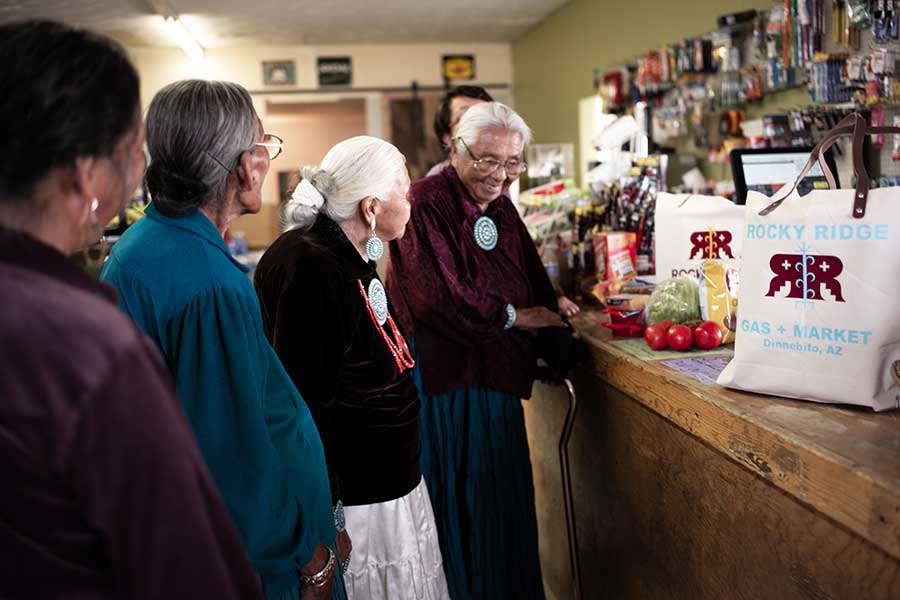
We are assisting the Sipaulovi Village Board and Enterprise Board to create a sustainable mixed-use development including an office complex, convenience store, gas station, office, and fast food facility.
Over the past year Trust interns Anna Masayesva, Cynthia Naha and, more recently, Jacquelyn Dyer, have worked with the Village board and administration to ensure a viable community-based strategic plan and the successful organization of a Village Enterprise Board to oversee both the Village’s existing business and start-up activities. The Hopi villages have pursued economic development in a way that ensures the business ventures are communal. As such, the design of the Village Enterprise Board is critical to future success as the design must respect Hopi cultural values and village goals while allowing for business autonomy at the same time. The Enterprise Board is currently comprised of several business owners including the manager of Hopi Credit.
We organized a two-day economic development seminar in the fall of 2004 that enabled village members and leaders to strategically design a master plan for the marketplace and ancillary businesses. Just as important, village members created a vision statement for the project that identified Hopi values that the project must not impede and values that should be incorporated into the project.
We also engaged Burlini/Silberschlag, Ltd., a Tucson architectural firm, to help the village with site planning and architectural schematics for the marketplace. The site plan and schematics ensure that local village leaders and citizens are fully comfortable with the scale and look of the proposed project.
The Trust and Village recently financed a full-fledged business plan that lays out type, scale, product mix, financing requirements, cash flow, marketing insights, and the type of employees that would be needed for the development.
A major accomplishment of the program was to back up all this work by procuring significant grant funding that will cover the costs of an enterprise business manager for a year, finance development, infrastructure and architectural development and, ultimately, construction and opening of the marketplace.
Monument Valley Resort and Vendor Village
Over the past year we advised the Navajo Tribal Parks and Recreation Department, Oljato Chapter, and the Monument Valley Vendors, on the development of the Monument Valley Resort and Vendor Village. We assured community input into the project planning, creation of an overall master plan and business plan, inclusion of conservation elements, and assisted the project managers in securing financing for $2 million worth of infrastructure.
We also organized a two-day strategic planning session for the Oljato/Monument Valley community to design a business plan that would ensure the successful start-up and sustainable operation of the new vendor village.
We continue to assist the vendors with organization of an entity that will manage a 40 booth vendor village, to be constructed at a cost of $1.9 million.
Little Colorado River Gorge Overlook
For generations the highway thoroughfares crossing the Navajo Reservation have served as both an important source of income and a defining way of life for Navajo roadside vendors. Nowhere is the roadside vendor more apparent than on the eastern leg of State Route 64 – one of only two gateways to Grand Canyon National Park’s South Rim. It is along this 25 mile stretch – just west of Cameron between US Highway 89 and the Park entrance – that vendors cluster to sell Navajo artisans’ work to traveling tourists.
In recent years however, the Arizona Department of Transportation (ADOT) has cited safety concerns as their reason for applying increased pressure on many roadside vendors to remove their stands from the highway shoulders within the transportation authority’s right-of-way. ADOT is especially concerned with areas it feels have inadequate turnouts or turning lanes for vehicles exiting and re-entering the highway.
The pressure applied by ADOT, combined with the desire to bring economic opportunities to the local community, gave the Second Overlook Vending Association, in conjunction with the Cameron Chapter, motivation to suggest construction of a regional destination area. The proposed destination area will serve as a centralized tourist attraction incorporating such features as a Navajo vendors’ market, traditional Navajo structures, a cultural area, and informational signage.
Commonly known as the “Second Overlook Area,” the site consists of approximately ten-acres located at the edge of the Little Colorado River Gorge. Its boundaries are largely defined by geologic features. The steep cliffs of the Little Colorado River Gorge dramatically mark the northern edge of the site. To the south, the site’s relatively flat topography is suddenly interrupted by the steep 2000 foot ascent of Gray Mountain. Further defining the site are the incisive Gorge drainages, which carve borders along the east and west edges. In addition to the aforementioned elements, the Second Overlook Area is blessed with remarkable views of the Painted Desert to the east.
After choosing the destination area, Al Johnson, the Second Overlook Vendor’s Association President, realized that in order to ensure successful completion of the project he would need assistance from the local community and outside organizations. The first person he called was Al Henderson with the Center for Native American Student Resources at Northern Arizona University. Johnson took Henderson on a tour of Highway 64 and introduced him to his development concepts for the Overlook. Henderson immediately fell in love with the location and said, “it has a heart warming feeling.”
Henderson then turned to the Grand Canyon Trust (GCT) and the Center for American Indian Economic Development (CAIED) for additional support. Both organizations felt they could offer project start-up assistance and agreed to volunteer their time.
In the spring of 2005, Jesse Stemmler, a University of California-Berkley landscape architecture master’s degree candidate, came to the Grand Canyon Trust. Originally from Flagstaff, Jesse wanted to work on a project close to home. Tony Skrelunas, Director of GCT’s Native America Program, chose to involve him in the Cameron project. Jesse’s first steps were to get design input from the community, learn about the land’s history and identify the area’s natural resources. His research process included a series of community meetings, surveys, and informal interviews.
Jesse’s design concepts are expected to be finalized by March 2006 and will rely heavily on the results of his community research. This community-based approach has won the hearts of many in the Cameron community. Al Johnson compares Jesse to a Navajo medicine man who is traditionally greatly respected and relied on to provide assistance.
Engaging the local community has been a key role for the Grand Canyon Trust and a central tenet of our success. At a meeting on January 4, 2006, several members of the local Cameron community along with representatives from Grand Canyon National Park, Southwest Windpower, CAIED, NAU’s Center for Native American Student Resources and College of Health Promotions, Navajo Parks and Recreation, and the Cameron Chapter came together at the Grand Canyon Trust office to offer their assistance with the project. It was an incredible collaboration of great minds and helped this project develop in a culturally sensitive manner.
With the aid of Arviso Business Consultants Inc., the Grand Canyon Trust recently helped the Second Overlook Vendor’s Association adopt bylaws for incorporation under the Navajo Nation. They are now ready to operate as a legal entity, which enables them to seek grant assistance. Over the next few months, the Grand Canyon Trust will be helping the association organize their new business and obtain grant funding. The Trust is excited for the Cameron community and hopes to see Phase I of the project completed by summer 2006.
previous
(Back to Native America Program Index) |