USGS official says uranium in Grand Canyon withdrawal is 1.5% of US total, not 40% as Az/Ut politicians say

Below is a copy of an email the Grand Canyon Trust received after questioning the unsubstantiated claims made by Arizona Reps. Gosar, Quayle, Franks, Flake and Senator McCain as well as Utah Reps. Bishop, Matheson, Chaffetz and Senators Hatch and Lee. All claim the withdrawal area contains 40% of nation’s uranium, a lie promulgated by ACERT, a uranium industry mouthpiece.

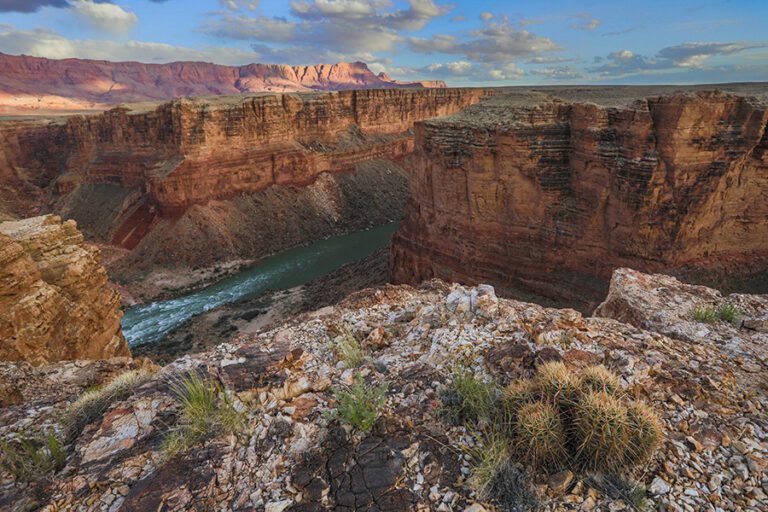
In 1980, the Department of Energy’s National Uranium Resource Evaluation (NURE) program estimated the totalundiscovered resource endowment for the US, and published these resultsin US Department of Energy report GJO-111(80). USGS is relying on the totalspublished in this report,  and endowment also calculated as part ofthe NURE program for some additional quadrangles not included in the originalreport but completed shortly after the publication deadline. As well, wehave added  USGS undiscovered uranium resource estimates for threeareas of the US that were completed after the end of the NURE program.These are studies of the Arizona strip breccia pipes, surficial depositsfound in the northwestern US, and sandstones of the San Juan Basin in NewMexico. When all of these studies are combined,the estimated uranium resourcescalculated for the US in all undiscovered resource categories are approximately8 million metric tons of U (tU). This presumes that minimal mining of uraniumhas occurred since the estimate was completed as compared to the totalundiscovered endowment. Using  an estimated 125,400  metric tonsof U (326 million lbs U3O8)  in the recently withdrawn areas aroundthe Grand Canyon, the undiscovered uranium resource calculated for thewithdrawn areas represents about 1.5 % of the total estimated US endowment.

However, I think the 3.7% figure that you calculated is defensible as well. We do not have access to the databases that were to calculate undiscovered resources at that time. Therefore we cannot correct for costs and changes in cutoff grades that were used in later published compilations of these estimates, such as that you found in the Encyclopedia of Chemical Processing and Design. Frankly given the nature of this resource as undiscovered and highly speculative, a range from between 1.5  to 3.7 is pretty tight; its appearance of precision may even imply that we have more knowledge of the location, size, and grade of uranium resources throughout the country than we really do at this time.

Please do not hesitate to contact me if you have any further questions about undiscovered uranium resources in the US. I will try my best to answer them; however, the state of knowledge about these resources is, as you can see, incomplete. For this very reason, USGS is working to develop better, updated estimates of these undiscovered resources in a project that initiated this fiscal year.

- Susan Hall
U.S. Geological Survey
Central Energy Resources Science Center
PO Box 25046, MS 939
Denver Federal Center, Bldg. 25
Denver, CO 80225

ph: 303-236-1656
email: susanhall@usgs.gov

Share
This entry was posted in Grand Canyon Issues. Bookmark the permalink.

Comments are closed.